

For the past 70 years, many process industries have relied on largely unchanged refractometer technology to monitor key liquid properties. Firefly Sensing is challenging the status quo. Leveraging breakthrough research in photonics, the company delivers real-time insights in areas previously inaccessible, all while significantly reducing costs.
How it began
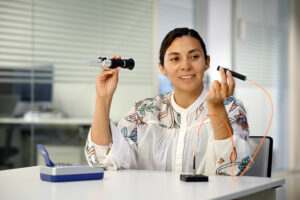
Mildred Cano, the driving force behind Firefly Sensing, has spent over 15 years immersed in fibre-optic sensing and photonics research. Starting in Mexico and later continuing as a postdoctoral researcher at Eindhoven University of Technology. Throughout this journey, Cano’s overarching mission has always been clear: to take innovations out of the laboratory and apply them to tangible, real-world problems.
Transitioning from researcher to CEO has been both thrilling and demanding. “Shifting from the lab to the business world is a major change,” Cano reflects. “In research, my focus was on developing optical and photonic sensors. Now, I navigate a landscape with new expectations, timelines, and challenges.”
The company’s name embodies both its technology and its philosophy. Firefly Sensing develops miniature sensors that use light to track liquid properties such as concentration and refractive index, a measure of how light bends as it travels through a liquid. The combination of small scale, dynamic functionality, and light-based operation made the firefly, a natural emitter of light, a perfect metaphor for the technology.
Rethinking Liquid Measurements
Today, many liquid-quality monitoring relies on refractometers, instruments that determine refractive index. Traditional refractometers, whether handheld or digital require manual sampling: a liquid is removed from the production line and measured offline. While accurate, this approach is slow and fails to provide immediate feedback, a limitation for rapidly changing liquids.
Inline refractometers do exist, but they tend to be bulky, expensive, and are based on the same technology since the 1950s. Their size and cost restrict their use in smaller reactors, microfluidic systems, and other compact setups. To move towards more sustainable and data-driven production, the industry needs a solution that is small, cost-efficient, and capable of continuous, real-time monitoring.
A Compact and Cost-effective Solution
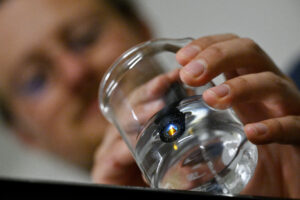
Firefly Sensing addresses this gap with a miniaturised inline sensor that continuously monitors liquids as they flow through production lines. The device delivers real-time information on parameters such as sugar content, alcohol concentration, and nutrient levels, enabling manufacturers to optimise product quality, reduce waste, and prevent spoilage without interrupting production.
The sensor itself measures under five millimetres on each side and is connected via optical fibres to a compact light source and readout unit. This unit interprets the optical signal to estimate the refractive index accurately. The overall system is designed to be significantly smaller and more affordable than existing inline refractometers. Its flexible architecture allows installation on virtually any transparent surface, making integration straightforward across a wide range of industrial setups.
The technology builds on years of photonics research, combining nanophotonic sensing elements with novel readout techniques to deliver a solution that is both highly precise and robust enough for industrial environments.
Generating Impact
Firefly Sensing’s first-generation devices are initially focused on applications in Food & Beverage and Bioprocessing, including dairy, juice, beer, and pharmaceutical production. These sectors represent early entry points where real-time insight into liquid composition delivers immediate operational and sustainability value.
Although Firefly Sensing was incorporated only last February, the company has already built strong momentum and reached several key milestones. It secured NWO Take-Off Phase 2 funding, and the core scientific work underpinning the technology was published in ACS Nano. The team has demonstrated and presented the technology at leading industry and research events, including the Food Tech Event, TU/e Research Day, Wageningen Agrifood Event, Drinktec, Slush, Web Summit, and NWO Chains.
Firefly Sensing was also selected for DT Launchpad and distinguished itself as the only startup from the Netherlands to advance to Phase 2 of the program. In parallel, the company was recognised in the Academic Startup Competition, where it was selected among the top 32 academic startups nationwide. With growing validation from both industry and academia, the team has now begun expanding, marking its first external hire.
What’s next?
By 2027, Firefly Sensing plans to be in the market and work on a second-generation sensor, while expanding its team with experts from the chemical, food, and beverage sectors to accelerate industrial adoption. The long-term vision is clear: to make compact, inline optical sensing a standard tool for liquid monitoring, replacing bulky legacy refractometers with scalable, real-time alternatives. By bridging cutting-edge photonics research and industrial usability, Firefly Sensing is demonstrating that even the most established measurement techniques can be reimagined, unlocking better control, greater efficiency, and more sustainable production.